The debate between carbon fiber and wood guitars boils down to a single question: do you crave the organic, evolving warmth of a traditional instrument, or the consistency and durability of a modern one?
This is the core of the modern vs traditional debate.
One path leads to soulful, classic character. The other to reliable, road-ready performance. Your choice will define your experience as a player.
The Modern Innovator vs The Timeless Classic

For generations, the acoustic guitar has been defined by the tonewoods used to build it.
We talk about the scent of mahogany, the beautiful grain of a spruce top, and that magical way an instrument “opens up” over years of playing.
But now, a new type of instrument has stepped onto the stage, built not from timber but from advanced composites.
Carbon fiber guitars, pioneered by innovators like Emerald Guitars, represent a fundamental shift in instrument design.
They aren’t trying to be wooden guitars; they’re engineered from the ground up to offer a completely different set of advantages rooted in material science.
The conversation around carbon fiber vs. wood guitars always comes back to a few key differences.
A High-Level Comparison
This isn’t really a “which is better” argument. It’s about which material is better suited to you and the music you make. A quick side-by-side look reveals two very different philosophies.
Quick Comparison of Carbon Fiber vs Wood
| Characteristic | Carbon Fiber Guitars | Traditional Wood Guitars |
| Tone | Consistent, clear, and powerful projection | Warm, complex, and evolves over time |
| Durability | Extremely resistant to dings and impacts | Fragile and susceptible to scratches and cracks |
| Climate Stability | Virtually immune to humidity and temperature | Requires careful climate control to prevent warping |
| Maintenance | Minimal to none, only occasional adjustments needed | Regular upkeep, can require professional setups every 6 months or so |
| Feel | Lightweight with advanced ergonomic options | Familiar, classic feel and weight |
A touring musician, for instance, needs an instrument that will perform flawlessly night after night, whether they’re in a dry theatre in Dublin or at a humid festival on the coast. For them, a carbon fiber guitar is a reliable partner. That peace of mind is a massive advantage for any working player.
On the other hand, a studio artist or home enthusiast might cherish the subtle tonal complexities and unique personality of a vintage wood guitar. For some, the ritual of caring for a fine wooden instrument is part of its charm.
Tone comparison
When you get right down to it, the carbon fiber vs wood guitars debate almost always kicks off with tone.
A wood guitar gets its voice from its very nature, its organic, cellular makeup. This inherent inconsistency is exactly what gives different tonewoods their legendary character.
Think of the scooped mids and bell-like highs of rosewood, the direct, punchy bark of mahogany, or the crisp shimmer of a spruce top.
The simple fact is, no two pieces of wood are ever identical, which means every wooden guitar has its own unique sonic fingerprint.
This uniqueness is both a gift and a curse.
Players fall in love with the soulful personality of a fantastic wood guitar, but finding that one ‘magic’ instrument can mean playing dozens of them.
On top of that, a wood guitar’s tone isn’t set in stone. It famously ‘opens up’ over years of playing as the wood resins crystallise, making the instrument feel more alive and responsive.
The Voice of Carbon Fiber
Carbon fiber guitars come at tone from an engineering angle.
The goals are consistency, clarity, and sheer power.
Because the material can be controlled with scientific accuracy, a builder can design an instrument to produce a very specific, repeatable sound.
This completely removes the tonal lottery you get with wood, so you know every guitar will deliver its intended voice.
This consistency is a massive advantage for professional musicians.
When you pick up an Emerald, like our popular X20, you know precisely what you’re getting. It’s a balanced, articulate, and powerful acoustic sound that’s the same from one guitar to the next.
This engineered approach leads to some key tonal traits:
- Exceptional Note Separation: Every note within a chord rings out clearly, without ever turning to mud. This is perfect for intricate fingerstyle arrangements or for cutting through a busy band mix.
- Powerful Projection: Carbon fiber tops are incredibly efficient at turning string energy into sound. Our jumbo-sized X30, for example, produces huge volume with very little effort, making it a monster on stage.
- Even Response: The tone is balanced across the entire fretboard, from deep lows to sparkling highs, without the ‘dead spots’ that can sometimes pop up on wooden guitars.
The Evolving Soul of Tonewood
Where carbon fiber delivers predictable precision, wood offers an evolving, organic soul.
The romance of a great wood guitar is tied up in its imperfections and its ability to change with you. Its soundboard vibrates with a warmth and complexity that so many players find familiar and deeply inspiring.
This evolving character is a huge part of the appeal of traditional guitars.
The subtle shifts in tone as an instrument ages forge a personal bond between the player and their guitar. For anyone who truly values that journey and the soulful ‘breath’ of a wood soundboard, that quality is irreplaceable.
But this organic nature brings variability. Something like ‘runout’ in a piece of wood (where the grain doesn’t run perfectly straight) can mess with its structural integrity and its sound.
As we cover in our deeper look at how carbon fiber has reimagined acoustic guitar tone, composites sidestep these natural limitations completely.
Ultimately, the choice often boils down to: do you prefer the predictable fidelity of an engineered material, or the unique, ever-changing character of an organic one?
Durability
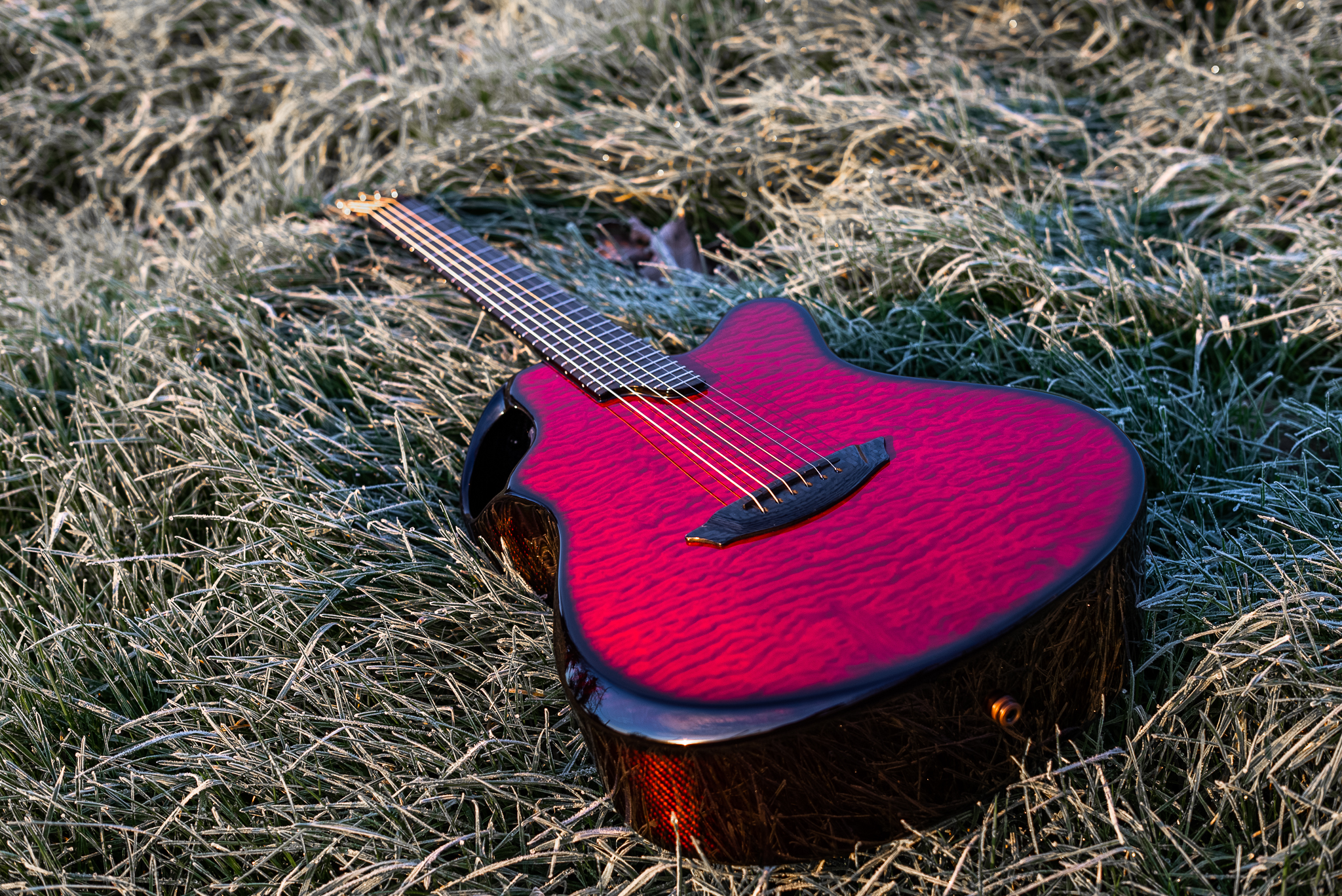
A traditional wood guitar is a thing of beauty, but it’s also a fragile instrument.
A carbon fibre guitar, on the other hand, is an engineering marvel built to handle the real world.
For any wood guitar owner, managing the climate is a constant source of low-level anxiety. Wood is hygroscopic, meaning it absorbs and releases moisture from the surrounding air, causing it to swell and shrink. This instability is the root cause of the most common, and often most expensive, guitar problems you’ll ever face.
This constant battle against the elements requires careful upkeep with humidifiers, dehumidifiers, and seasonal check-ups. It’s a delicate balancing act that many musicians, especially those who travel, find endlessly stressful.
The Stability of Carbon Fibre
Carbon fibre guitars are, by contrast, almost entirely immune to these environmental threats.
They are built as a single piece of polymer composite – what we call a unibody or single-piece design – with no glue joints that can fail and no wood grain that can warp, crack, or swell.
This resilience makes carbon fibre the superior choice for anyone who needs their instrument to be a reliable tool, not a fragile antique. Emerald Guitars, hand-crafted in the famously damp and unpredictable climate of County Donegal, Ireland, are a perfect testament to this weather-proof design.
A Real-World Durability Test
The real-world benefits of carbon fibre construction are more than just theory.
Here in Ireland, these guitars have transformed what’s possible for touring musicians facing our island’s notorious weather.
Ireland sees over 225 rainy days a year, with humidity in coastal areas like Donegal often swinging between 70-90%.
Such conditions can make a traditional wood guitar detune by up to 20% during a single performance.
In contrast, Emerald’s single-piece carbon fibre models like the X20 and X30 maintain their pitch accuracy to within 1%, even after exposure to extreme humidity and temperature changes that wood simply cannot handle.
We even put one of our guitars through the wringer to see if it could survive the intense rain and heat of Louisiana.
You can explore the full research on the growth of the carbon fiber instrument market for more details.
This stability translates directly into several key advantages for you as a player:
- No More Seasonal Adjustments: Your guitar’s action and intonation stay consistent all year round. That means no more frequent truss rod tweaks.
- Carefree Travel: Take your guitar on a plane, to the beach, or on a camping trip without fearing damage from the climate.
- Reduced Lifetime Costs: You save significant money by avoiding common wood-related repairs like cracked tops, lifting bridges, and neck resets.
Maintenance
When you pit carbon fibre against wood, the long-term upkeep reveals two totally different ownership experiences.
One demands high upkeep, while the other offers something close to total low upkeep freedom.
Owning a traditional wood acoustic comes with a set of non-negotiable rituals.
Because wood is a living, breathing material, it reacts to everything around it, demanding a careful relationship with its owner.
The Upkeep Rituals for Wood Guitars
A wood guitar is always in flux, swelling in the damp and shrinking when it’s dry. This constant movement puts huge stress on its joints, finish, and overall structure.
To fight this, owners have to become part-time meteorologists, managing their guitar’s microclimate with a whole toolkit of humidifiers and routines.
Common maintenance tasks become a regular part of life:
- Diligent Humidification: This means using in-case or room humidifiers to nail that ideal 45-55% humidity range. It’s the only way to stop the wood from drying out and, in the worst-case scenario, cracking.
- Seasonal Truss Rod Adjustments: As the neck wood shifts with the seasons, so does the neck relief. This throws your action and playability out of whack, often requiring a tweak of the truss rod to get the guitar feeling right again.
- Managing Repairs: Even with the most careful ownership, wood guitars can suffer expensive damage. Common jobs like fixing top cracks, re-gluing a lifted bridge, or the dreaded neck reset can set you back hundreds, if not thousands, of euros.
The Low-Upkeep Carbon Fibre Advantage
Carbon fibre guitars are designed from the ground up to make these worries disappear.
Their composite construction and one-piece body design mean they are fundamentally inert. They simply don’t swell, shrink, or warp, no matter what the weather is doing.
This stability translates directly into a hassle-free life for the owner, saving you time, money, and stress.
Playability & feel

We can talk about tone and durability all day, but the carbon fibre vs wood guitar debate really comes down to one simple question… how does it feel to play?
That physical connection between you and your instrument is where the magic happens. And in this arena, the two materials couldn’t offer a more different experience.
A traditional wood acoustic brings a deep, ingrained familiarity. For generations, guitarists have become accustomed to the squared-off edges, the distinct balance, and the comforting heft of a dreadnought or jumbo. It’s a classic feel we know and love.
But that classic design has its limits.
Wood can only be bent and braced in specific ways, which keeps luthiers tied to long-established shapes.
Adding features like deep body contours or integrated bevels is difficult, expensive, and can even be structurally risky, potentially creating weak spots or messing with the guitar’s tone.
The result is a design that players have learned to adapt to, rather than one that is adapted for the player.
A New Frontier in Guitar Comfort
Carbon fibre starts life as a flexible fabric, ready to be moulded into almost any shape imaginable before being cured.
This process blows the doors wide open for ergonomic innovations that are simply out of reach for wood.
- Integrated Contours: A forearm bevel stops the guitar’s sharp edge from digging into your arm, and a rib-rest contour lets the instrument settle comfortably against your body.
- Seamless Neck Joints: Carbon fibre makes it possible to create necks that blend directly into the body without a clunky heel, giving you unrestricted access all the way up the fretboard.
- Lighter Weight: Carbon fibre boasts an incredible strength-to-weight ratio. The result is a guitar that’s noticeably lighter than its wooden counterpart, which means less shoulder and back strain during those marathon gigs.
Ergonomics in Action
A model like the Emerald X10 is purpose-built to be a comfortable, compact, and incredibly playable guitar, featuring a contoured heel and body bevels for absolute comfort.
Likewise, the X20 shows just how much more comfortable a full-sized acoustic can be. Its thoughtfully sculpted bevels and lightweight body make it feel far less cumbersome than a traditional wooden dreadnought, without giving up an ounce of volume or tone. This ergonomic design makes it a go-to for players who need an instrument that will feel great for hours on end.
Ultimately, while a wood guitar gives you the comfort of tradition, a carbon fibre instrument provides the comfort of thoughtful, modern design.
Who should choose what
The old debate of carbon fibre versus wood isn’t really about finding one “best” guitar. It’s about finding the right guitar for your musical life.
It’s about matching an instrument’s fundamental strengths with how you actually play and create music.
Once you understand what makes each material special, you can pick a guitar that doesn’t just sound incredible but feels like a genuine partner on your journey.
To help you figure that out, let’s look at four common player profiles. See which one sounds the most like you.
The Touring Pro
For the musician living out of a suitcase, reliability is the name of the game.
You need a guitar that delivers night after night, whether you’re in a bone-dry theatre or a sweltering outdoor festival. The last thing you need is the constant nagging worry about a wood guitar’s tuning, shifting action, or the risk of a top cracking from climate shock. That’s a distraction you just can’t afford.
This is precisely where a carbon fibre guitar proves its worth as an indispensable workhorse. Its total immunity to temperature and humidity means it’s ready to go, straight out of the case, every single time.
- Your Go-To Choice: A road-tested carbon fibre model like the Emerald X20 or the incredibly versatile Virtuo hybrid. These instruments guarantee consistent tone and rock-solid stability, giving you the peace of mind to focus on nothing but your performance.
The Recording Artist
In the studio, it’s all about having the right sonic colours for your palette.
A recording artist needs to capture the perfect sound for a specific track, and that often means having a range of different tonal characters on hand.
One song might cry out for the crystal-clear articulation of a modern instrument, while the next needs the organic warmth and complex overtones of a vintage classic.
For the studio musician, the choice isn’t “either/or” – it’s both.
Carbon fibre brings a predictable, pristine clarity that sits beautifully in a dense mix, while a great wood guitar provides irreplaceable character and organic texture that can make a track breathe.
The Passionate Hobbyist
For the player who makes music mostly at home, the experience is about more than just the sound.
It’s about the whole sensory connection to the instrument. The rich scent of the tonewood, the feel of the grain under your fingertips, and watching the guitar’s voice mature and change with you over the years.
Even the little rituals of caring for a fine wood instrument are part of the joy.
This player cherishes the living, breathing quality of a traditional guitar. The subtle imperfections and soulful character aren’t seen as flaws; they are the very things that make the instrument feel personal and uniquely theirs.
- Your Ideal Companion: A beautifully crafted wood guitar that you can build a real, long-term bond with. Its evolving voice becomes part of your own musical story.
The Adventurous Player
Do you dream of playing your guitar on a boat, around a campfire, or on a sandy beach?
For the adventurous musician, a fragile wood guitar can be a source of constant anxiety. The risk of sand, water, or sudden temperature swings causing irreversible damage often means the guitar gets left behind.
This is where a compact, durable carbon fibre guitar shines. Its tough, weather-proof construction completely removes that fear, freeing you to bring your music along, no matter where life takes you. It becomes a true travel companion, always ready for a spontaneous session in any environment.
- Your Perfect Match: A rugged and portable carbon model like the Emerald X7. Its smaller body is comfortable and a breeze to transport, while its carbon fibre build ensures it can handle any adventure you throw at it.
Conclusion: No “one-size-fits-all,” but clear use cases
When you’re weighing up a decision this big, it’s natural to have a few final questions floating around.
The choice between carbon fibre and wood is packed with nuance, so let’s tackle the most common ones head-on to clear up any lingering doubts.
Can a Carbon Fibre Guitar Really Sound Like Wood?
The short answer is, it’s not trying to.
Carbon fibre offers a different sonic flavour that’s incredibly clear, balanced, and consistent. It’s more about high-fidelity sound than imitation.
Guitars like our Emerald X20 are celebrated for their rich, modern voice that has no trouble cutting through a busy mix.
They don’t replicate the organic “breathing” or unpredictable aging of a vintage wooden guitar, but they deliver a professional-grade tone that’s become a preference for many players.
Its reliability and pristine articulation are huge assets, especially when you’re on stage or in the studio.
Are Carbon Fibre Guitars Actually Worth the Money?
For any player who travels, gigs regularly, or lives in a place with shifting weather condintions, the answer is a firm yes.
The upfront cost might be similar to a high-end wood guitar, but the real value unfolds over time.
Think about the long-term savings:
You’re sidestepping all those climate-related repair bills for cracks or neck resets. You can ditch the humidifiers. For a working musician, that bulletproof durability means no lost income from a guitar being out of action.
It’s an investment in consistency, reliability, and pure peace of mind.
Just How Tough Are They, Really?
While they’re not literally indestructible, they are astonishingly durable.
Carbon fibre guitars can shrug off the dings, scratches, and environmental shifts that would be catastrophic for a wood instrument.
The usual suspects like cracks from low humidity or a warped top from a hot car are complete non-issues.
Could a severe, sharp impact cause damage? Sure. But the real-world benefit is freedom from worry. Think of them as road-worthy tools built to handle the chaos of travel and constant use, not museum pieces you’re afraid to touch.
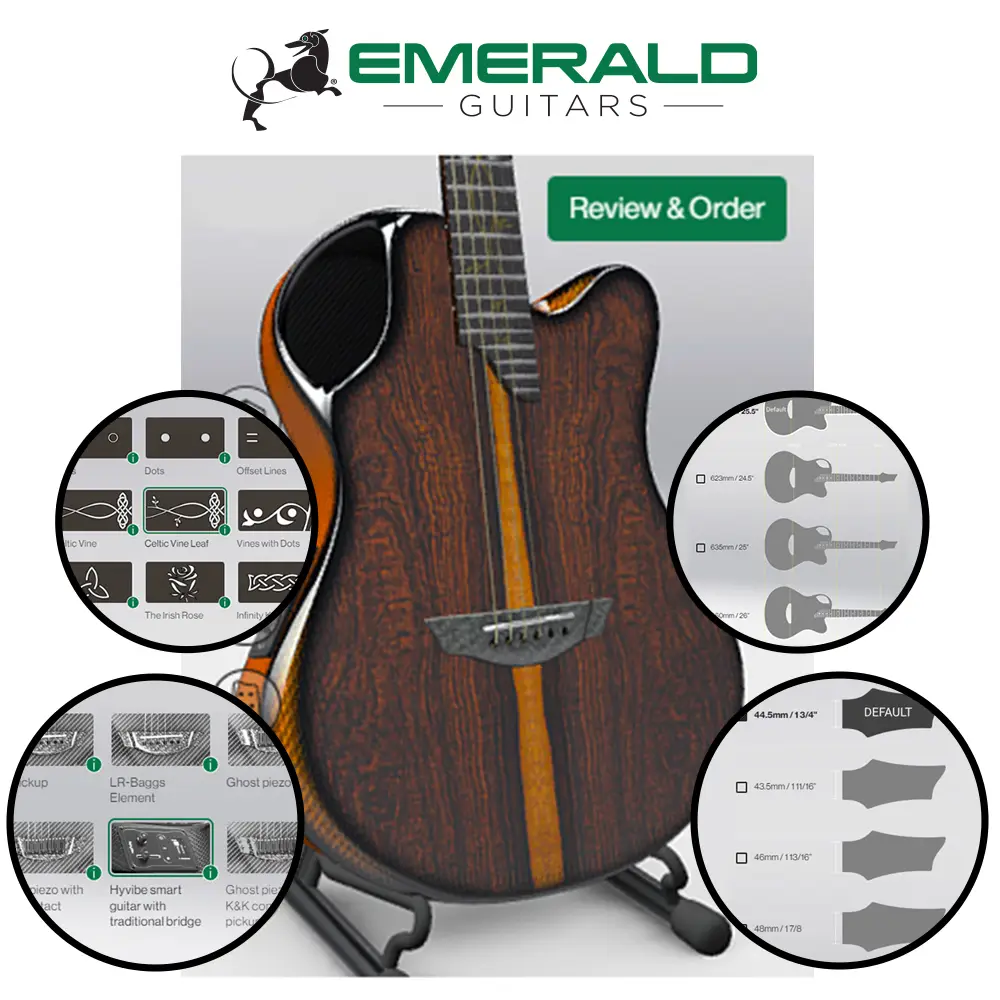
Ready to feel the stability, comfort, and powerful tone for yourself? Take a look at our models currently in stock, or jump right in and design your own perfect instrument with the Emerald Guitars 3D Guitar Builder.